Dora Carrington how did she cope through her sexuality?

Dora Carrington 1893-1932 was an English painter and decorative artist, she mainly remembered mainly due to being part of the Bloomsbury Group association. She suffered with her sexuality and had an affair with Henrietta Bingham as well as having a relationship with writer Gerald Brenan, Bloomsbury was a name commonly used to identify a circle of intellectuals and artists who lived in Bloomsbury near central London, in the period 1904–1940.
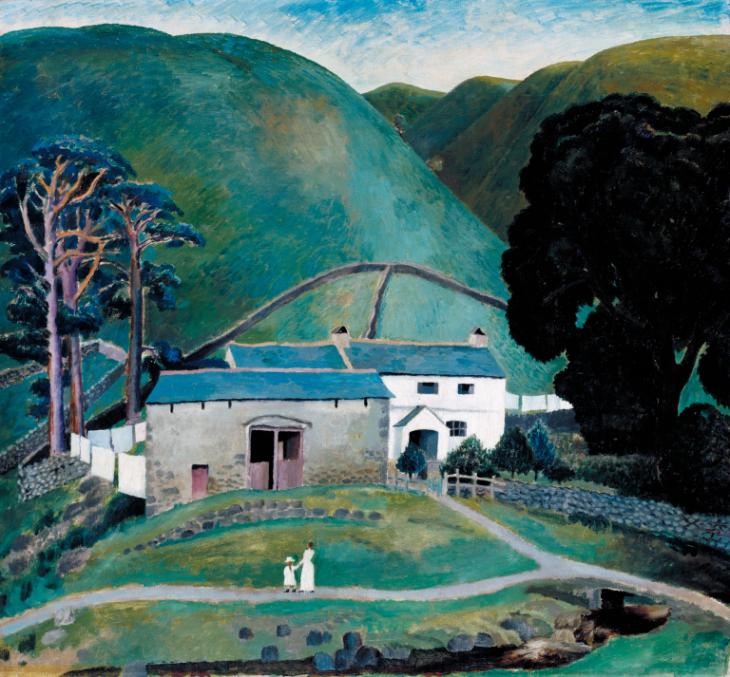
Title: Farm at Watendlath, 1921
Medium: Oil Paint on canvas
Collection: Tate Modern

This created tension on coping with her emotions, in her diary she wrote: “She is odd from her mixture of impulse & self-consciousness. I wonder sometimes what she is at: so eager to please, conciliatory, restless, & active…. But she is such a bustling eager creature, so red & solid, & at the same time inquisitive, that one can’t help liking her.” This was based on how she was not coping with her sexuality at the time and covering it up instead. Reference: https://en.wikipedia.org/wiki/Dora_Carrington

In 1921 she then married Ralph Partridge although this was not for love but to hold the ménage à trois together, although in 1926. Ralph began having an affair with Frances Marshall and soon went to live with her in London. The affair energized Carrington’s artistic creativity, and she also collaborated with Penrose on the making of three films. However, Penrose wanted Carrington exclusively for himself, a commitment she refused to make because of her love for Strachey. The affair, her last with a man, ended when Carrington became pregnant and had an abortion.

During her lifetime, her work received no critical attention. The lack of inspiration may have kept her from displaying her artwork. Her work can be portrayed as progressive since it did not fit into the typical of art in England at the point in time.

In fact, her work was not considered art at all. It featured Victorian-style pictures which were made from coloured tinfoil and paper. Carrington included pen sketches in letters to her friends, with the intention of entertaining them. She also created woodblock prints, which were highly regarded. Her lesser-known work included painted pub signs and murals, ceramics, fireplaces, and tin trunks. Reference: https://en.wikipedia.org/wiki/Dora_Carrington
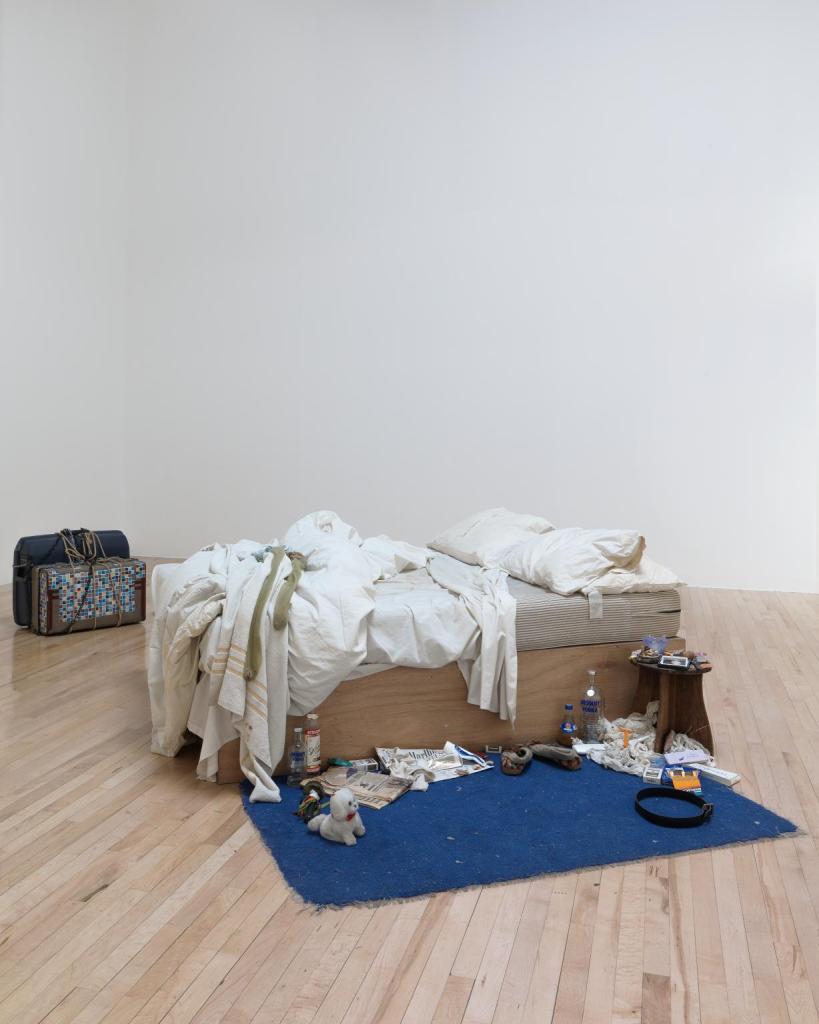
Tracey Emin, did her mental breakdowns influenced her work?

My Bed 1998 Tracey Emin
Medium: Box frame, mattress, linens, pillows and various objects
Dimensions: Overall display dimensions variable
Collection: Lent by the Duerckheim collection 2015
on long term loan

I decided to focus on Tracey Emin, due to her promoting and trying to reduce the stigma of mental health. This empowered me to focus on her work, due to mental health does have a stigma around the subject which needs to be broken. Her work creates emotion and trauma on how the suffering on mental health has affected and inspired for artwork.

Tracey Emin born 1963 and is currently alive, her movement involvement is Installation Art and Feminist Art. She is an English Artist known for her historical artwork. Emin produces work in a variety of media including drawing, painting, sculpture, film and photography.

Her childhood was traumatised at 13 when she was raped whilst living in Margate, she created work around this “what happened to a lot of girls”. Her work has been focused around this period which she also suffered with child abuse and sexual assault.

Her mental health would create ideas for her installations and would often appear drunk at the Turner Prize Awards. In 1997, she slurred whilst walking out from the interview: “Are they really real people in England watching this programme now, they really watching, really watching it?” Reference: https://en.wikipedia.org/wiki/Tracey_Emin

This did not give a good impression as this was her first time becoming known, and as well her work had comments on how it was unclean and unhygienic, as she used “yellow stains on the bedsheets, condoms, empty cigarette packets, and a pair of knickers with menstrual stains The bed was presented as it had been when she had stayed in it for several days”. Reference: https://en.wikipedia.org/wiki/Tracey_Emin

Although this resembled the meaning of being suicidal as her relationship difficulties affected her deeply, the name of that piece was called ‘My Bed’, 1998. Her comments were from two performance artists called Yuan Chai and Jian Jun Xi, “jumped onto the bed with bare torsos to “improve” the work, which they thought had not gone far enough”. Reference: https://en.wikipedia.org/wiki/Tracey_Emin

What helped Louise Bourgeois during her mental breaking points?

Louise Bourgeois was a known French American Constellation artist, born 25th December 1911 – 31st May 2010. Her best-known work was her large-scale sculptures and installation piece, she would also produce paintings and create prints. She was also involved with surrealism, Feminist Art and Abstract Expressionism.

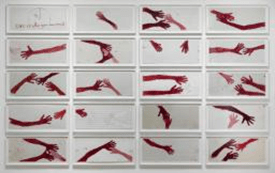
 Title: 10 am is When You Come to me, Made in 2006.
Medium: 20 etchings with watercolour, pencil and gouache on paper
Dimensions:
Image, each: 380 × 910 mm
frame, each: 478 × 1006 × 40 mm
Collection at Tate and National Galleries of Scotland. Lent by the Artist Rooms Foundation 2013

Throughout her career she explored different themes involving domesticity, family, sexuality, the body, lastly death and unconscious, which are connections to her events from her childhood.

I think this created a coping mechanism of showing how she recreated her traumas into her artwork, and that created strength into her being able to do this. Reference: https://www.tate.org.uk/art/artists/louise-bourgeois-2351

Louise Burgeois died of heart failure on 31 May 2010, at the Beth Israel Medical Centre in Manhattan. She had continued to create artwork until her death, her last pieces being finished the week before.

The New York Times said that her work “shared a set of repeated themes, centred on the human body and its need for nurture and protection in a frightening world.” Her husband, Robert Goldwater, died in 1973. She was survived by two sons, Alain Bourgeois and Jean-Louis Bourgeois. Her first son, Michel, died in 1990.  Reference: https://en.wikipedia.org/wiki/Louise_Bourgeois

This artist used her art to reflect her traumas throughout her printmaking and sculptures to reflect her pain. This shows that mental health can make art personal and emotionally reflecting on the persons experience.

In my opinion, for artists to use their personal trauma into their work for a coping mechanism creates strength in an artist and more less inspiration from that artist. 

How did Frida Kahlo overcome her mental and physical illness through art?

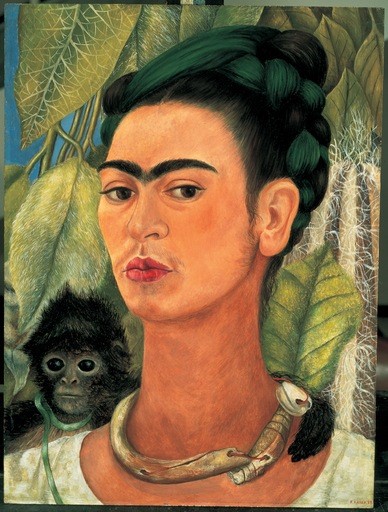
Title of work: Frida Kahlo Self-Portrait with Monkey 1938, Displayed in Tate Modern Museum

Frida Kahlo was a Mexican Painter who was born 1907 and died 1954. She is now one of the most known female artists of the twentieth century. Her work is currently displayed in the Tate Modern Museum and has an exhibition dedicated to her pieces of work and was involved with surrealism.

Frida Kahlo suffered with multiple mental health issues as well as physical disabilities throughout her life, which influenced her style of work, , as well as having a impacted relationship with artist Diego Rivera at age 22 when he was 44 at that time, this triggered episodes of depression and suicide attempts.

Her most memorable features in her work are her use of nature in the backgrounds of her work and as well as, her use of eyebrows in her self-portrait as a unique mark of her work.

It is stated that in Kahlo’s review in The Guardian that her work was more political, religion and communism, in the article written. “Scholars have devoted themselves to the influence of religious symbols, Mexican communism and folk art on Kahlo’s painting, and this show will take in all three – the costumes she copied, the votive emblems she collected, the photographs of Lenin, Stalin, Marx and Trotsky (with whom she had an affair) pinned above her bed. – Laura Cummings. Reference: https://www.theguardian.com/artanddesign/2018/jun/10/frida-kahlo-making-her-self-up-v-and-a-cindy-sherman-spruth-magers-review

It is known that ‘at least one third of her paintings are self‐portraits, in which she dramatically expresses her struggles with pain, depression and sorrow, intertwined with vivid images of flowers, monkeys and surreal elements, making her art a striking unforgettable experience.’ Reference: https://onlinelibrary.wiley.com/doi/full/10.1111/bdi.25_12616

This shows that pain can be influenced for artwork and that it can create a coping mechanism throughout her life by her details in her work shows emotions through painting. Her diagnosis of multiple illnesses did not stop her creating pieces of work, instead this created a unique blend of style and passion towards her work. Her details in this piece of work that I have chosen, reflect on how influenced and determination using painting as a coping mechanism away from physical trauma or mental wellbeing issues.  

Claude Monet,how did he use his wellbeing in art?

Claude Monet sometimes became frustrated with his work and according to some reports, he destroyed several paintings (about 500 pieces of work). He would simply burn them, cut or kick the piece and this was due to his outbursts, as well as depression and self-doubt. This was shown more to his near late artwork such as, his mental wellbeing became more and more intense as he struggled to hide this.

His mental wellbeing was so bad that he attempted suicide a year after his first child was born and he would use painting as a distraction and although he would tend be frustrated on his work, he would use this as an escape from reality.

He wrote to a friend “Age and chagrin have worn me out. My life has been nothing but a failure, and all that’s left for me to do is to destroy my paintings before I disappear.” Although he still worked on his paintings until his end of life.

Monet also wrote “My only merit lies in having painted directly in front of nature, seeking to render my impressions of most fleeting effects”. Even though his mental wellbeing was affecting him, he would still see art in a form of inspiration. Reference: https://www.biography.com/artist/claude-monet

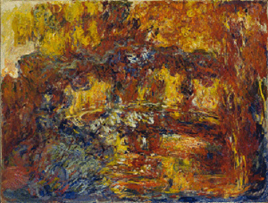
Japanese Footbridge (1920-1922)

This was one Claude Monet’s last paintings of a collection, made between 1920-1922. While the paintings in the earlier series are more realistic in design.

The later works appear to be more swirls and loose strokes of colour, that made it less recognisable of the bridge. Reference: https://www.moma.org/collection/works/79254

Vincent Van Gogh’s artwork and his wellbeing

Introduction to my Blog:

The focus onto this blog is to reflect the ways nature has influenced artists in different ways. It could be their mental wellbeing, spiritual or inspiration for work through painting.

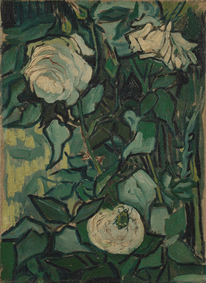
Roses 1890, oil on canvas
Displayed at Van Gogh Museum in Amsterdam

For my first post, I have decided to look at one of Vincent Van Gogh’s modernist impressionism work called Roses in 1853-1890 and how his work influenced him from his mental wellbeing at that time period. He was born 1853, Neverlands and died 1890, France.

The painting was an oil on canvas and is held in the Vincent Van Gogh museum in Amsterdam, originally the flowers in his painting were indeed pink not white and can see the hints of the pink pigments through the white due to the bleaching of the pigment used.

Reference: https://www.vangoghmuseum.nl/en/collection/s0187V1962?v=1

He is known for his indecisive last-minute changes in his work due to his mental wellbeing and how he reflected himself into his work. I decided to write about this artist due to his inspiration of his life and as well as his artwork. He is one of my most influenced artists in my work as an artist.

His ideas behind the piece of work was to create a contrast of light colours and dark. He decided to add an insect into his painting lastly, this may due to his last moment decisions or doubting on his work. His work has expressed himself through his mental wellbeing and although we greatly appreciate his work now. He saw it as just another piece of work that he expressed himself throughout his life. It was not important at the time when he was alive, and people did not value art at that time of period.

At that time era, there was not any mental health support for Vincent Van Gogh, even though he was still depressed and had psychiatric illness he put this into his work as it is known that people with this tends to be creative. Over the years he created so many pieces and although this was a coping strategy he still struggled very much.

A reviewer called Albert Aurier (1865-1892). He surprisingly reviewed his work during his lifetime and was in fact a painter/art critic himself. He described Vincent Van Gogh work, as the only painter he knew. “who perceives the colouration of things with such intensity, with such metallic, gem-like quality”.

Reference: https://www.thoughtco.com/first-reviewer-of-van-goghs-paintings-2578999

Design a site like this with WordPress.com
Get started